
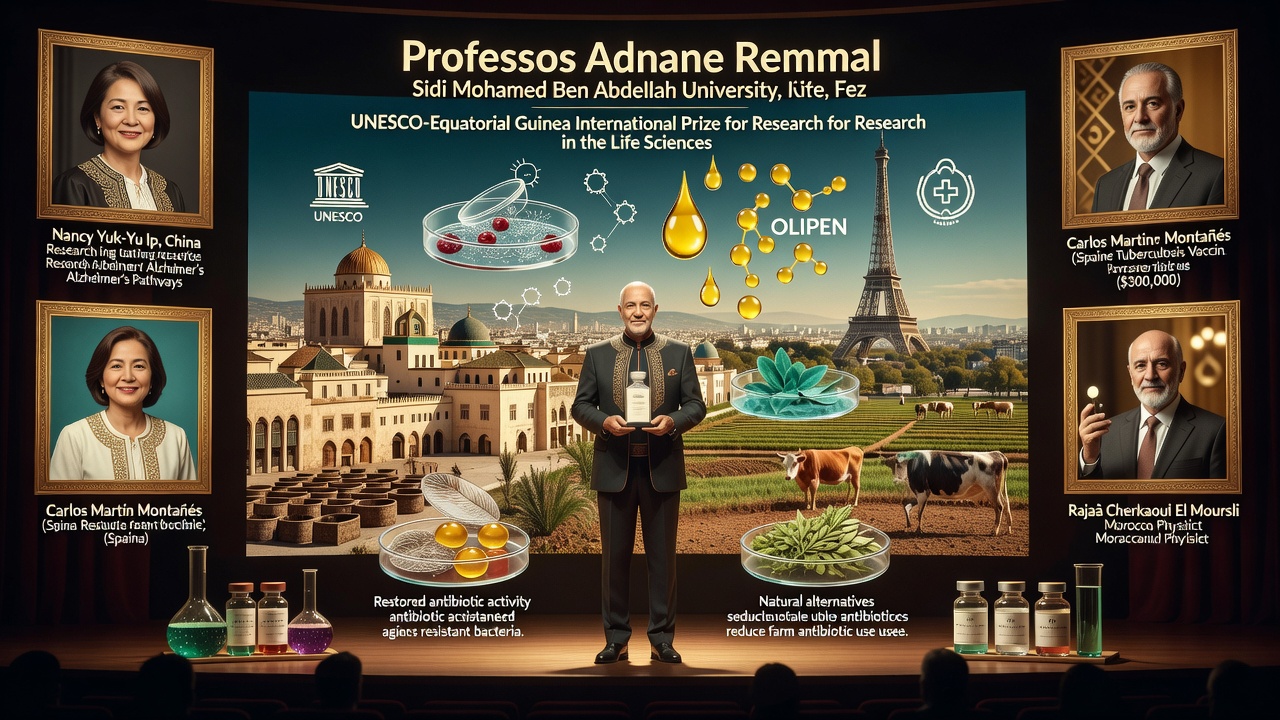
Adnane Remmal, a professor at Sidi Mohamed Ben Abdellah University in Fez, shared the UNESCO-Equatorial Guinea International Prize for Research in the Life Sciences in Paris this week. The award recognizes his work on antibiotic resistance, which is one of the most pressing problems in medicine today. He received it alongside two other researchers, from China and Spain.
A different approach to resistant infections
Remmal developed a medicine called OLIPEN, which pairs an existing antibiotic with an essential oil component. The combination is designed to make the antibiotic work again against bacteria that have stopped responding to it. The treatment has been approved for clinical use in Morocco, which opens new therapeutic options there.
In a statement to the Maghreb Arab Press agency, Remmal said his strategy relies on restoring the effectiveness of current antibiotics rather than designing entirely new molecules. He argues that this path can lower development costs and shorten timelines, which could make treatments more affordable and easier to reach. He added that hundreds of thousands of patients in Morocco have already benefited.
Reducing antibiotic use on farms
Remmal has also developed natural alternatives to antibiotics for livestock. The stated goal is to cut how much antibiotic is given to animals, since heavy use in farming is widely linked to the spread of resistant bacteria. Lower use could support safer, more sustainable food production, though the supplied reporting does not describe the scale of any farm trials.
The other winners and the prize
Chinese neuroscientist Nancy Yuk-Yu Ip was recognized for her research on the brain and Alzheimer's disease. Carlos Martín Montañés of Spain was honored for his contribution to developing a tuberculosis vaccine. The jury was chaired by Moroccan scientist Rajaâ Cherkaoui El Moursli. The three winners share the prize, now in its tenth edition, which carries a total award of $300,000.